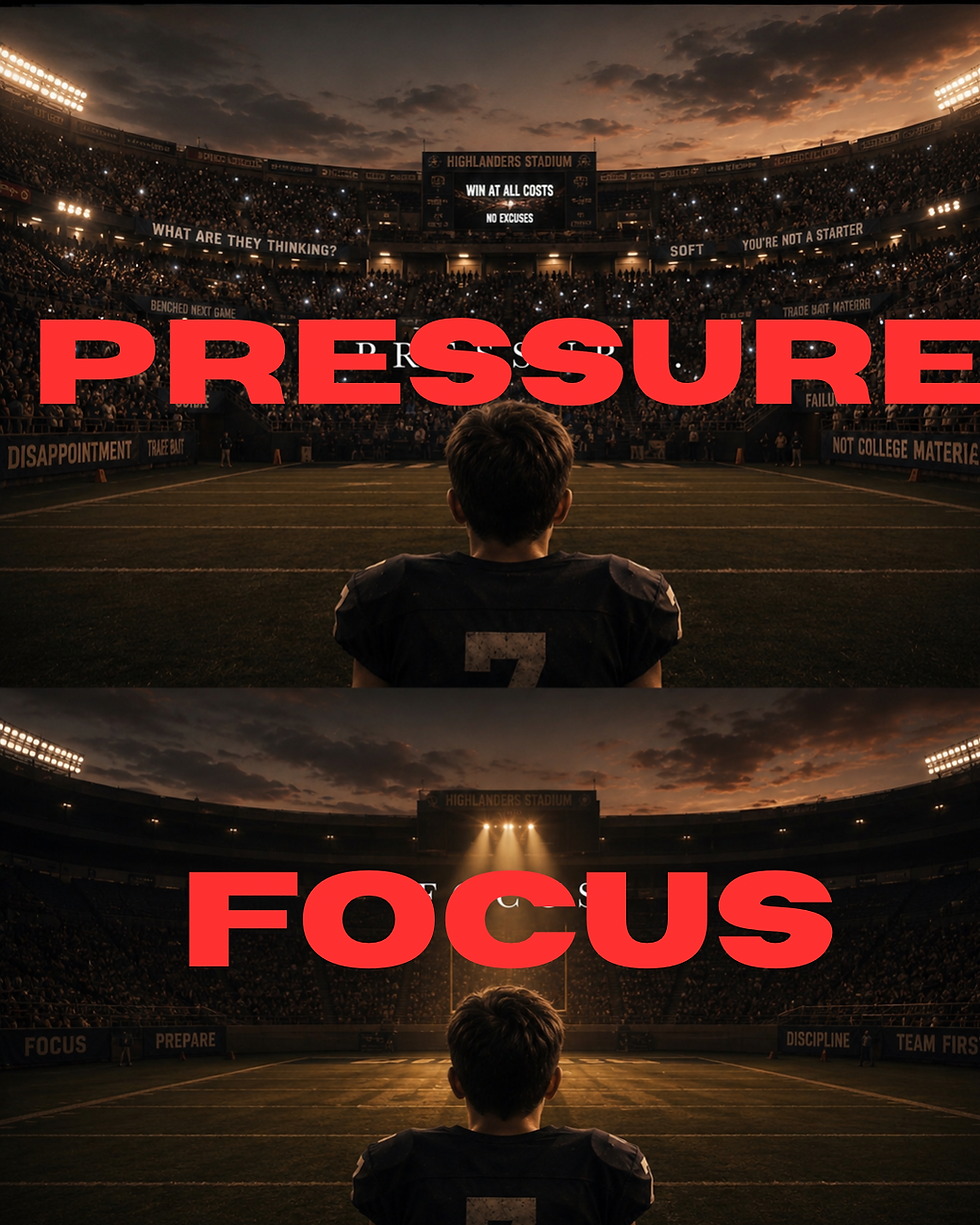
PRESSURE vs. FOCUS: Why Today’s Athletes Are Losing the Mental Game

Athlete mentality training
Walk into almost any high school stadium on a Friday night, and you’ll see more talent than ever before.
Athletes are bigger. Faster. Stronger.
They have access to trainers, camps, recruiting services, highlight videos, social media exposure, and information that previous generations could only dream about.
Yet despite all these advantages, many young athletes are struggling.
Not because they lack ability.
Not because they aren’t working hard.
They’re struggling because they’re listening to too many voices.
They’re worried about:
What people will post.
What coaches will think.
What their friends will say.
How many likes they’ll get.
What happens if they fail.
Whether they’re ranked high enough.
Whether they’re getting enough attention.
Whether they’re receiving enough scholarship offers.
The modern athlete lives in a world of constant evaluation.
Every practice can be recorded.
Every game can be clipped.
Every mistake can be replayed.
Every performance can be judged by people who have never stepped onto a field.
As a result, many athletes spend more time thinking about how they look than how they perform.
And that’s where the problem begins.
Pressure becomes louder than preparation.
The Lesson Football Taught Me
When I played college football and later in the NFL, the only time I really looked at the crowd was when we ran out of the tunnel.
The music was loud.
The stadium was packed.
The energy was incredible.
But once the game started, all of that disappeared.
There could have been 150,000 people in the stands—or nobody at all.
It didn’t matter.
Because the crowd wasn’t making the blocks.
The crowd wasn’t running the routes.
The crowd wasn’t making the tackles.
The crowd wasn’t spending hours in the weight room.
The crowd wasn’t out there during the hottest days of summer conditioning.
It was me and my teammates.
Nothing else mattered.
The game was played on the field, not in the stands.
The opinions were in the stands.
The work was on the field.
Too many athletes today have that relationship reversed.
The Audience Has Become the Assignment
Somewhere along the way, athletes started focusing more on the audience than the assignment.
They’re watching who’s watching them.
Checking who viewed the story.
Monitoring comments.
Comparing themselves to other athletes.
Tracking rankings.
Obsessing over exposure.
Wondering why another athlete got an offer first.
Worrying about whether they’re getting enough attention.
The irony is that none of those things actually make you better.
A coach has never awarded a scholarship because someone got more likes.
A recruiter has never offered an athlete because their highlight video had more views.
At the highest levels of sports, performance still wins.
The athletes who earn opportunities are usually the ones who spend the least amount of time worrying about them.
They focus on development instead of validation.
Pressure Isn’t the Enemy
Many athletes believe successful people don’t feel pressure.
That’s not true.
Every athlete feels pressure.
Every athlete experiences doubt.
Every athlete gets nervous.
The difference is where they place their attention.
Elite athletes don’t waste energy fighting pressure.
They simply refuse to stare at it.
Pressure is unavoidable.
Distraction is optional.
The athletes who consistently separate themselves aren’t the ones who feel less pressure.
They’re the ones who refuse to give pressure control over their thoughts.
Instead of focusing on expectations, they focus on execution.
Instead of focusing on outcomes, they focus on actions.
Instead of focusing on what everyone else is thinking, they focus on what they need to do next.
The Power of the Next Play
One of the greatest mental skills an athlete can develop is the ability to focus on the next play.
Not the last mistake.
Not the last drop.
Not the missed tackle.
Not the bad game from last week.
Not the scholarship offer they didn’t get.
The next play.
Because sports reward athletes who can reset quickly.
The best quarterbacks throw interceptions and come right back.
The best receivers drop passes and continue attacking.
The best teams make mistakes and keep competing.
Why?
Because they understand something many young athletes forget:
You cannot perform in the past.
You can only perform in the present.
Pressure pulls your attention away from the moment.
Focus pulls it back.
Pressure asks, “What if I fail?”
Focus asks, “What’s my job right now?”
Pressure looks at the crowd.
Focus looks at the next rep.
Pressure looks at the rankings.
Focus looks at the process.
Pressure creates anxiety.
Focus creates results.
Confidence Is Earned
One of the biggest misconceptions in youth sports is that confidence comes from external validation.
Athletes believe confidence comes from praise.
From offers.
From followers.
From rankings.
From attention.
Those things may create temporary excitement, but they don’t create lasting confidence.
Real confidence comes from preparation.
It comes from knowing you’ve done the work.
It comes from showing up when nobody is watching.
It comes from finishing workouts.
It comes from mastering fundamentals.
It comes from doing the little things consistently over time.
That’s why some athletes remain calm in big moments.
It’s not because they magically become fearless.
It’s because preparation has given them something stronger than fear.
Trust.
Trust in their training.
Trust in their habits.
Trust in the work they’ve already put in.
Final Thoughts
If you’re an athlete reading this, here’s something worth remembering:
The crowd doesn’t determine your future.
Social media doesn’t determine your future.
Comments don’t determine your future.
Rankings don’t determine your future.
The work does.
Stop worrying about being judged.
Stop chasing validation.
Stop focusing on things you cannot control.
Instead, focus on preparation.
Focus on discipline.
Focus on development.
Focus on the next rep.
Focus on the next play.
Because when preparation meets opportunity, pressure gets real quiet.
And that’s when athletes perform at their best.

Comments